Friday, November 9, 2007

The Wall

Another Brick in the Wall” was Pink Floyd's title for the three songs variated for the same basic theme. It was on their 1979 Concept Album, “The Wall”, subtitled Parts 1, 2 and 3 respectively that all of which were written by Roger Waters, Pink Floyd's lead songwriter and bassist.


We Don't Need No Education” was the popular line for the Part 2 version and was released as a single, and the band's only hit in the UK, US and Germany and some parts of Europe. A Protest Song however was their first single since 1968 entitled “Point Me at the Sky”. It was about the fixed schooling and boarding schools which eventually were banned in some countries.


A Choir was needed for Pink Floyd's Part 2 and was instructed by Alun Renshaw from Islington Green School. Choir members were not permitted to hear the entire song and were let down as they wanted to hear more from Gilmour's solo from the song. The Choir's sound was overdubbed 12 times to have its impression larger and was paid £1000 though there were no royal contract arrangement.


Though Bob Seger won the Grammy for Best Performance by a Rock Group, and Pink Floyd had only its nomination, black students adopted their song as a protest anthem during the uprising in South Africa that was against the racial propaganda in 1980 and were eventually banned by its government on May of the same year.


The Music Video version of Part 2 featured students beginning their protest against the teachers and causes them to become more isolated from the society. Where a student imagines his classmates walking towards a machine and seeing them to the other end with masks, sitting at their chairs, with the teacher seen dressed in a gown, giving commands to students, while at the same time the students were singing the chorus of the song. A total chaos where in the end the students hammered all the walls and surprisingly led to an enormous bonfire.One of the most Interesting part in the history of Classic Music. The Wall by Pink Floyd.


Check out Online DVD Auction at DVD.tv for more Great Musical Classics Online.


Thursday, November 1, 2007

Ground Control to Major Tom

Ground Control to Major Tom” is a famous line from the song "Space Oddity". A song written and performed by David Bowie. Major Tom is an astronaut who was lost in outer space and is a fictional character as well. Space Oddity ranks as one of the best known Bowie songs.


Space Oddity represents the best of early years of David Bowie, and gives the listener a good idea about where this musician was headed in his later work. The album is dominated with an acoustic theme, but there's some good rock & roll as well. It was released in the UK in 1969.


The song was sometimes interpreted to be about destroying oneself and estrangement from humanity. Major Tom's cryptic last message, "Though I'm past one hundred thousand miles - I'm feeling very still - And I think my spaceship knows which way to go - Tell my wife I love her very much", suggests that he is still alive and well and chooses to kill his circuit to ground control. Bowie seems to confirm this interpretation with his 1980 follow up to "Space Oddity", "Ashes to Ashes", where Ground control eventually receives a message from Major Tom.


The song may be considered as an implied comparison for the different view of a person with an altered state of consciousness, may it be through some sort of substance or some other means, and suggest to such elements of pop culture. A Space Odyssey, its overt reference is to a lost or stranded astronaut, and thus draws upon public awareness of the US space program, which was well-known throughout the 1960s.


This is one of Bowie's biggest, and points up one of his favorite themes that of all things extraterrestrial. A gloomy, dark acoustic guitar in a minor key fades in to begin the song, accompanied by some tasteful chiming licks on the electric guitar. Another must have album for people who have a taste on highly refinement in words and music.


Check out DVD.TV for more Great Musical Classics Online.
Friday, October 26, 2007

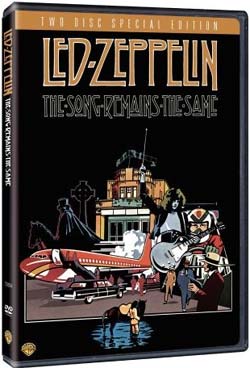
The Song Remains the Same

A Documentary footage of Led Zeppelin at the height of their power in 1973 with bizarre fantasy sequences.

Led Zeppelin were either the greatest live rock band ever or a bunch of pompous musos with a frankly adolescent fascination with witchcraft. Either way, they were a significant Rock 'n' Roll group, sitting between the electric blues bands and psychedelic rockers of the 60s and the heavy metal that was to come.

Led Zeppelin's initial popularity was based as much on the band's concerts as its albums, and The Song Remains the Same, released in conjunction with the pseudodocumentary film of the same name, reproduces the very things that made Led Zeppelin concerts legendary. Lengthy solos intertwining interplay between Jimmy Page and Robert Plant and ridiculously long songs as "Dazed and Confused" is nearly a little over half-hour.

Led Zeppelin have always been my favourite band but since I saw this I have a whole new respect for them. After you watch this, you'll realize how good Jimmy Page really was, especially on the 25 minute Dazed And Confused where he played with a violin bow, it's crazy. Robert Plant was great but I think he could of sang a bit better. John Bonham's drum solo in Moby Dick is very impressive. And John Paul Jones plays the bass and keyboard very solidly.


A very good buy and definitely a must for all the ex and present rockers out there. You can never find another Led Zeppelin nowadays, that's for sure.


Check out DVD.tv, an online DVD auction site for more Great Musical Classics Online.

Friday, October 19, 2007

The White Album

It's one of those records that lives it's own life. It's so varied, so long and informative, that you'll never get over it. And the songs only keep growing. The funny thing about this record is that it somehow doesn't sound like The Beatles. It's somewhat darker, more mystic and intellectual that anything else they ever did. Beyond its stylish minimalism, the essentially blank cover of The Beatles, better known as the White Album, served a symbolic purpose. The band could find no honest way to visually represent itself as a coherent unit. Each of the three main songwriters was pursuing his own vision, with the other members, however reluctantly, serving as backup musicians. Once a whole far greater than the sum of its parts, the Beatles were now a tense alliance of daunting individual talents.


Another favorite tune of mine found on The White Album is the old western sounding "Rocky Raccoon", written by John and Paul while in India of all places, with some help from '60s rock star Donovan. Lennon is my main man in the Beatles, but this album marks some of Paul's best contributions to any of the Beatles albums. I mean, take the masterpiece song "I Will",only thing wrong with this sweet number is that it is too short. "Ob-La-Di-Ob-La-Da" and "Birthday" were both co-written by Lennon and McCartney, but Paul started writing each of these songs before John joined in to help finish them.


The same as the U.K. set except: A Hard Day's Night was issued in its original French format as 4 Garcons Dans Le Vent. The records were pressed in France with their original labels (Odeon and Apple). Rarities was put out on EMI. The box was four inches thick, larger than any other edition, and the individual album titles were printed on the back. The Beatles (White Album) was listed as Back In The U.S.S.R.


Paul McCartney - acoustic & electric guitars, flute, flugelhorn, piano, Hammond organ, bass, drums, bongos, timpani, percussion
George Harrison - vocals, acoustic & electric guitars, violin, organ, bass, tambourine, firebell
Ringo Starr - vocals, piano, drums, bongos, maracas, castanets, tambourine
John Lennon - vocals, acoustic & electric guitars, harmonica, saxophone, piano, organ, harmonium, bass, 6-string bass, maracas, tambourine, tape loops


Finally, this is definitely a must-have album from the Fab Four. A truly superb experience in a double CD compilation of the most genuine masterpiece from the British Pop Legends


Check out DVD.TV for more Great Musical Classics Online